Biometric Verification for Benefit Delivery: Reduce Fraud and Improve Access
Government benefit programs (healthcare, pensions, cash aid) lose integrity and effectiveness when fraud, duplicate enrollments, and ghost beneficiaries slip through eligibility checks. Biometric verification for benefit delivery closes the gap at the point of service: a fingerprint or face check binds each benefit payout to a single verified person and prevents duplicate IDs across programs. Senegal’s CMU (Couverture Maladie Universelle, the National Universal Health Coverage Program) already runs this model nationwide, using biometric checks to confirm eligibility at every healthcare clinic.
May 2026Fraud Drains Government Benefit Programs
Without biometric verification, eligibility checks rely on paper IDs, visual inspection, and subjective staff judgment at the point-of-service counter. Three patterns of fraud exploit those gaps in almost every government program. That fraud diverts precious funds and denies the truly under-served from receiving their share of the benefits.
Ghost Beneficiaries
Someone, other than the intended beneficiary, continues collecting a pension, benefit or grant after the actual beneficiary has died or moved outside the jurisdiction, using their name and ID details. The program has challenges knowing the ghost beneficiary is not who they claim to be and that the legitimate beneficiary is no longer alive or eligible.
Impersonation at the Counter
Anyone who knows a beneficiary’s name, date of birth, personal details and/or ID number can show up at a counter and collect a benefit on their behalf. Visual checks provide low confidence about who is actually standing across the counter.
Duplicate IDs and Multiple Claims
The same person enrolls more than once under slightly different details to claim the same benefit multiple times. Without a biometric record, the duplicate IDs go undetected.
“The question isn’t whether the right name is on file. It’s whether the person collecting the benefit is alive, is who they claim to be, and hasn’t already received the benefit.”
Handheld Biometric Verification at the Point of Service
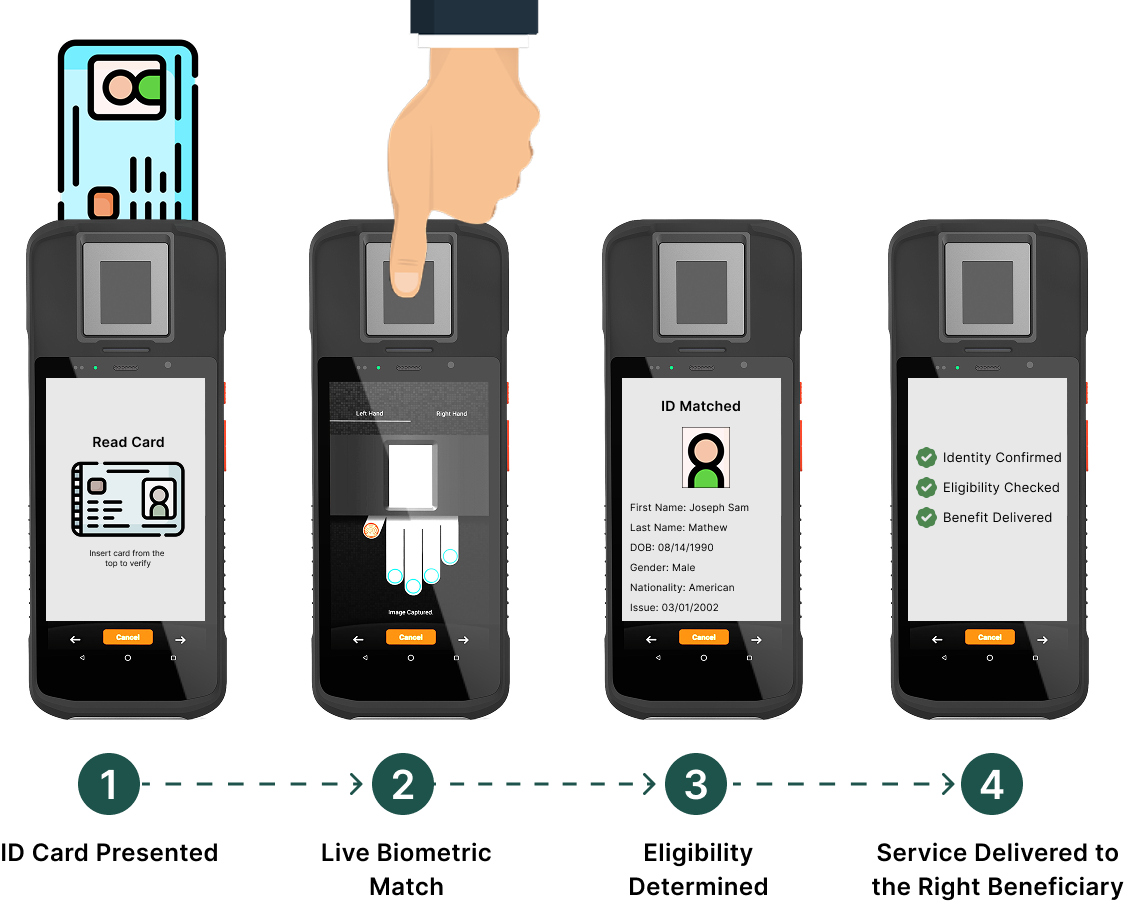
Handheld biometric verification devices replace visual ID checks with a live fingerprint or face match at the counter. The device captures a biometric, matches it against the citizen’s ID card, and confirms eligibility in seconds. The verification also provides compliance reports as proof that identity was checked and confirmed.
That single check addresses all three fraud patterns. A live biometric proves the beneficiary is alive at the moment of benefit payout. A fingerprint or face match confirms the person collecting the benefit is who they claim to be, and biometric deduplication blocks the same person from enrolling multiple times under different details.
Here is how one verification runs at a clinic, a pension window, or a cash-aid counter.
Senegal’s CMU: Biometric Patient Verification at National Scale
CMU (Couverture Maladie Universelle) is Senegal’s national universal health coverage program and a flagship of the country’s Plan Sénégal Émergent. The program aims to bring health coverage to every citizen, with a particular focus on “informal sector” workers who have no formal employment record.
To run the program economically and reliably while keeping fraud out, Senegal’s CMU equips clinics and field teams with 1,200 CredenceTAB™ units, handheld biometric verification devices built for the difficult conditions clinic staff actually work in. The device offers wireless communication for remote sites, battery power that doesn’t depend on a stable power grid, and a rugged, compact form factor one person can carry without a setup team or fixed installation.
Each device reads the person’s ID card, captures a fingerprint or face, and confirms eligibility on the spot. The same compact device handles enrollment, verification, and audit logging. That is what reduces fraud risk and keeps every payment tied to the right citizen. The device can match the person to the card provided or, if no card is available, match against the central database stored on the system of record within Senegal.
“Before biometric verification, every audit was a guess at how much of the spend reached the intended citizen. Now every line item ties back to a person who showed up and was confirmed.”
From Manual Checks to Verified Service
Ghost and Fraudulent Beneficiaries Eliminated
Borrowed cards, claims filed under deceased identities, and duplicate enrollments stop at the verification step. The three fraud patterns that drained the program of funds before don’t make it past the counter. Every benefit claim now ties back to a living, verified, and eligible beneficiary.
Real-Time Eligibility and a Clean Digital Audit Trail
Coverage status and claim routing run automatically, not through manual reconciliation. Every verification writes a tamper-resistant record that auditors and program financiers can trace back to a real person. Reconciliation stops being an analog guess or estimate.
On-the-Spot Verification, Anywhere a Counter Opens
Handheld biometric verification devices like CredenceTAB™ run the same check across clinics in low-connectivity districts, rural outreach points, and urban hospitals. The device works all day on battery, and if there is a network outage, it syncs when the network returns, so service can continue even when the network is down.
Built to Scale Beyond Senegal
Healthcare is where Senegal’s CMU started, but the benefits of this model don’t stop there. The same biometric verification check, on the same handheld device, can confirm the right person at a pension window, a cash-aid drop, or a food-subsidy counter anywhere in the world. Field staff carry CredenceTAB™, so no fixed installation, no setup team, no waiting on the grid.
The same approach fits any government delivering benefits to verified citizens. Each rollout is customized for the program’s eligibility rules, the country’s identity infrastructure, and the field conditions staff work in. Senegal is one example. The next deployment can look different and still run on the same model.
Deploying Fraud-Resistant Benefit Delivery?
Governments and development partners are working with Credence ID to adapt this platform to their national contexts. Talk to our team, or see the products deployed today.
Related Resources
BMO Stadium: Automated ID Verification at Scale
How a major venue cut ID check times by 3x with Tap2iD Verifiers.
Read case studyProductCredenceTAB™
The ruggedized biometric tablet built for field and clinic deployments.
View productIndustry SolutionHow Biometric Handheld Scanners Make Law Enforcement Safer and More Efficient
Rapid field identification, checkpoint verification, and warrant lookups with the Credence 3.
Read full story